

There is no vaccine or cure for Potato Virus Y, which has led to challenges for growers in the San Luis Valley
by Helen Xu | Westword
Humans have largely moved on from the COVID-19 pandemic, but unbeknownst to most, potatoes have been experiencing their own global pandemic for decades.
Because potatoes are grown by replanting them, they are more susceptible to viral infections than other vegetables, as each generation is essentially a clone of the parent and will automatically inherit its diseases. As the generations propagate, any virus present accumulates and builds in each generation.
The industry is split among two types of growers: seed growers, who specialize in growing healthy seed potatoes; and commercial growers, who purchase those seed potatoes, cut them up, plant them, and ultimately produce the potatoes found in grocery stores.
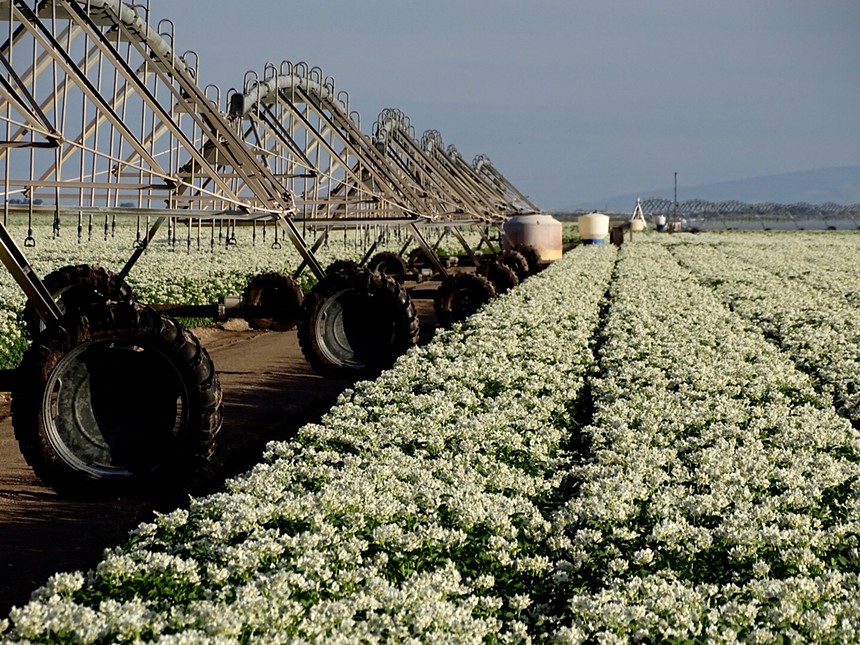
In Colorado, 100 percent of seed growers and the majority of commercial growers reside in the San Luis Valley. The location’s isolation can be beneficial — its fields are more protected from out-of-state disease — but its farmers and potatoes also have few defenses if a new disease is introduced.
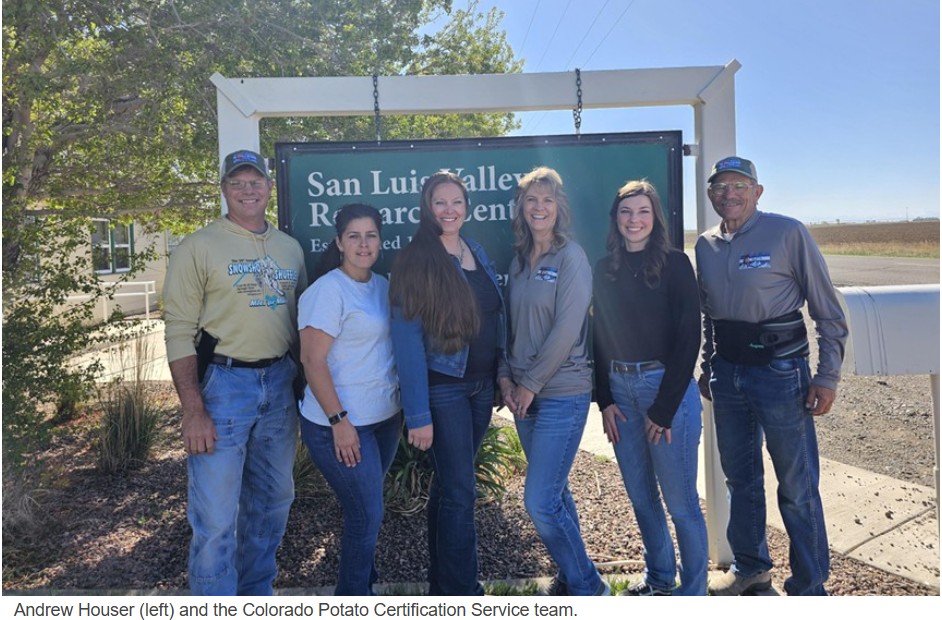
That’s what experts think happened roughly 25 years ago, when an out-of-state potato likely introduced Potato Virus Y (PVY) to the San Luis Valley. “A potato infected with PVY is safe to eat,” explains Andrew Houser, manager of Colorado State University’s San Luis Valley Research Center Potato Certification Program, but it does affect yields: “Based on research I have done, there is a reduction of about 150 pounds per acre for every 1 percent increase of PVY.” For a 100 percent infected field, that would equate to a 27 percent decrease in potatoes grown each year.
As with virus-infected humans, a PVY-infected potato is weaker and more susceptible to other diseases. “When you get higher levels of virus in the system like that…well, it just makes sense that there’s opportunity to have mutations and deleterious effects,” explains James “Jim” Ehrlich, who has been the executive director of the Colorado Potato Administrative Committee for the past eighteen years.
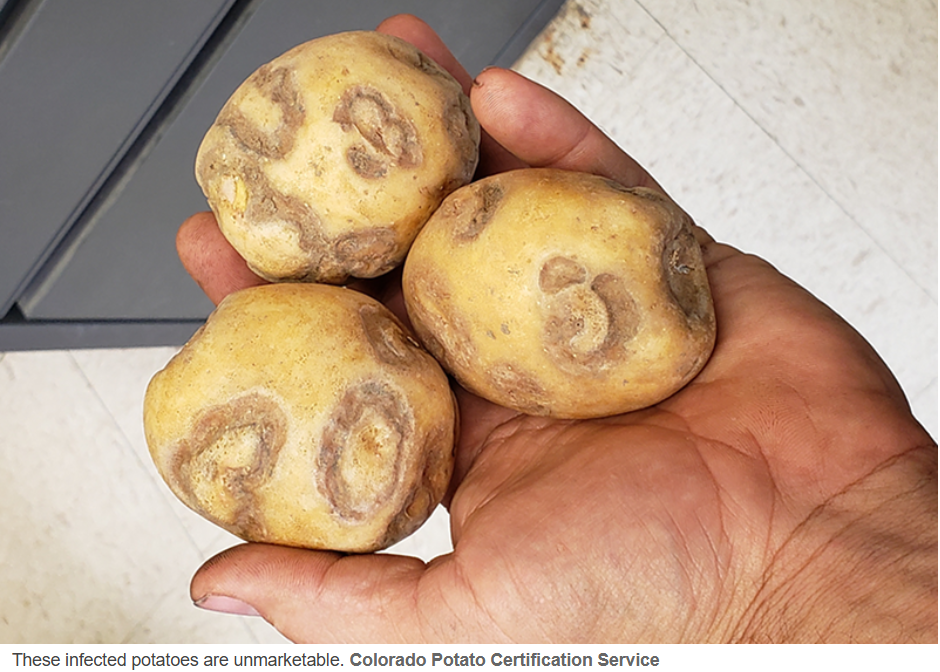
CPAC was founded in 1941 by the Potato Marketing Order Act as a trade organization and advocate for the San Luis Valley potato growers. “There are necrotic strains called PVYN and PVYNTN that actually cause tuber necrosis, so it causes internal damage in that tuber, and that potato is unmarketable. … At this point, the popular varieties don’t show much tuber necrosis, but we’re seeing increases in other varieties,” Ehrlich notes.
There is no vaccine or cure for PVY, and the virus is spread by aphids. Once it appeared, it wasn’t long before all potato farmers in the San Luis Valley, both seed and commercial, started testing positive for PVY, and levels have gradually gotten worse every year.
In 2012, the Colorado Legislature passed the Colorado Seed Act, which required growers to purchase only certified seed and set the PVY threshold at 5 percent. In other words, commercial growers could only plant seed potato crops where fewer than 5 percent of potatoes tested positive for PVY, a threshold that the industry considers enough to stop the viral spread.
However, the law gave commercial farmers a loophole: It also allowed them to plant a second generation of uncertified potatoes. It was a missed opportunity to cut the PVY infection off at its knees. Other states such as Idaho, Montana and Washington do not allow second-generation plantings, and instead require potato growers to grow only certified seed for every generation.
Second-generation uncertified potato fields average 25 percent PVY, and farmers have seen levels up to 80 percent. At that rate, aphids had a large enough reservoir of infected potatoes to continue the spread of PVY throughout the San Luis Valley. Soon, those second-generation fields contaminated enough seed growers’ fields that they couldn’t keep their crop below the 5 percent threshold to stay certified.
“So about ten years ago, we were certifying about 15,000 acres. … Last year we certified 8,000 acres because [seed] growers have not been able to raise a high enough quality of potatoes to meet our standards,” says Houser.
With a decreased availability of certified seed, San Luis growers have had to go to Montana to purchase clean seed. But, adds Ehrlich, “I spoke with one of [the Montana seed growers] last February, and he said he couldn’t supply any more than he is today. And these Montana seeds cost more money, and they have diseases that we don’t have…yet.”
This year, Senator Cleave Simpson, Representative Matthew Martinez and fellow colleagues submitted SB24-137: Planting of Uncertified Potatoes, which required commercial growers to test and certify their second-generation potatoes. However, “not everybody thinks it’s as big a problem as it is. And some are on the cusp of declaring an emergency. It just runs a whole gamut in it,” says Simpson, who grew up in the San Luis Valley and grew potatoes himself.
Essentially, this issue pits seed growers against commercial growers. Many seed growers are panicking as neighboring farms contaminate their seed, raising their PVY levels above 5 percent and risking their certification status. At that point, their only option is to convert their farms to commercial growing; there’s “only 40 percent of the seed growers that there used to be when I started this job in 2006,” Ehrlich says.
On the other hand, commercial growers pay a hefty price for certified seed potatoes. The certification process is not cheap — Houser’s laboratory charges anywhere from $20 to $30 per acre to run tissue cultures and assays on the leaves and potatoes. “We also require our certified growers to submit a 400-tuber sample to us at harvest time,” he adds. “We ship those to Hawaii, plant them and do visual inspections and leaf testing in December. This is our post-harvest test,” which costs $520 per farmer.
Houser estimates it would cost a commercial grower $76,000 to purchase enough certified seed to plant 120 acres versus the magnitudes-smaller cost of holding back part of your potato stock to re-plant. Then there’s the psychological effect of denial. “Sometimes farmers think, ‘I don’t have problems in my field.’ There’s a little bit of, like, raising kids — like, well my kids are angels,” Houser says.
So as SB24-137 moved through committee and the floor, it got watered down. “We’re not going to set any standards that say you can’t plant [second-generation uncertified potatoes]…but at least have it tested,” says Simpson. “I was trying to intentionally avoid penalizing people, but [instead] incentivize people to help participate and get a better handle on the scale and scope of the problem. And maybe, I don’t want to raise alarm, but maybe that will give us a sense of urgency that we’d better be more aggressive.”
“I am one of the key people that was against the idea, and I think a lot of growers just don’t like the idea of more rules and regulations, and I totally understand that. I personally feel like we’re regulating agriculture out of business in this country,” adds Ehrlich. “But you can’t ignore a problem, either. You have to try to find a solution. You have to be proactive.” He also wants to see more resources devoted to developing new potato breeds that are resistant to PVY, and for farmers to abandon susceptible varieties like the Russet Norcota, currently the most popular breed in the San Luis Valley.
“No one will notice. I mean, if we continue to not do anything for five to ten more years, then potentially you could notice a diminished supply, but you won’t notice it this year or the next,” says Simpson.
“People don’t really understand,” Ehrlich adds. “They’re just like, ‘Oh, food costs too much.’ And they’re right: Prices have really gone up, but not for potatoes. We’re working hard. Farmers love what they do — they’re working for you. … This is just another challenge for us.”