

Council also adopts six-month planning moratorium on marijuana shops should ballot measure pass
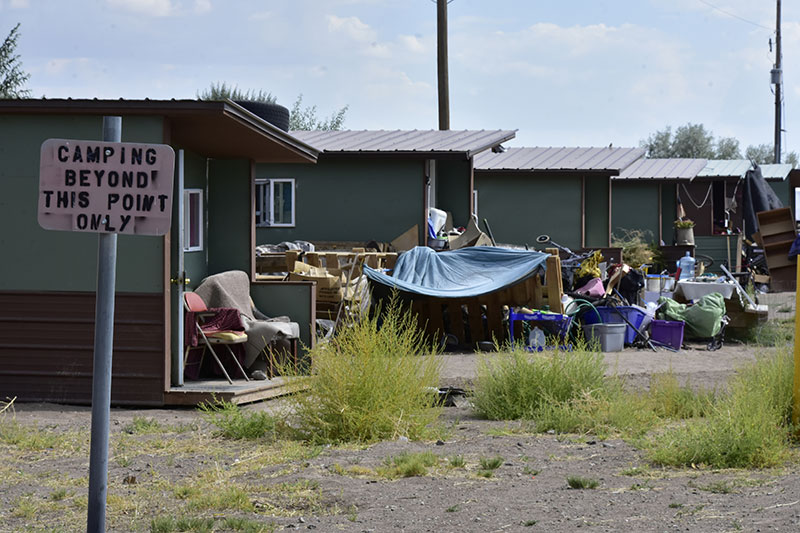
Image Credit: John McEvoy
Campers and residents of St. Benedict will have to adhere to a new set of rules after the Alamosa City Council adopted them Wednesday night, as a way to give the city more teeth in combating some of the issues stemming from “tent city.”
The council did not make any major changes to the proposed draft of rules. The only addition they made was to specify the prohibition of prostitution at the camp after claims and concerns of prostitution arose during a city council meeting earlier this summer.
The Alamosa Homeless Coalition spent four hours over the course of two meetings going over the language and the details of the new rules and sent their recommendation to city staff.
St. Benedict already has a list of 10 rules that have existed since the camp was established. Some of these old rules have not been removed, but developed more with more emphasis on consequences for breaking them.
Managing the camp is a difficult task. There is no on-site manager. Having a manager would be a significant cost the city doesn’t seem keen on funding. They have relied instead on La Puente outreach for managing and understanding what’s happening at the camp. The Alamosa Police Department’s community service officers are typically at the camp once a day and mainly work enforcement. With the new rules, the community service officers will be the main source of enforcement.
The new rules will require residents to make progress in getting help or utilizing services that would put them in a position to leave the camp. After six months, residents will be evaluated and if they are found to be using their services and still need more time, they will be allowed to stay at the camp for another six months.
Those who are not making an effort to get help can potentially be trespassed and unable to stay. The city is leaning on trespassing to keep the peace at tent city. Since the property is owned by the city, those who are deemed to be trespass-worthy can be kicked out. However, city manager Heater Sanchez said that trespass orders could be held in different categories, such as trespassing someone as to prevent them from living there, but still giving them the ability to visit St. Benedict.
A person can be trespassed from being at St. Benedict for any reason. In order to be allowed to live back in St. Benedict after being trespassed, they need a letter signed from the chief of police.
These rules come after a city work session meeting in early August where the discussion of entirely closing the camp arose. After the U.S. Supreme Court overturned City of Grants Pass v. Johnson, municipalities gained the legal grounds for how they enforce homelessness. Before the ruling, municipalities could only move homeless people from public spaces as long as there was an established camp or resource center. Alamosa has La Puente and St. Benedict.
Now, officers can simply move people along.
Alamosa Chief of Police George Dingfelder, in the August work session, said that his officers frequently respond to calls at the camp. At the time of the meeting, he said that since the camp opened in 2020, his office had responded to 830 calls of service, which included 52 assaults, 12 violent and sexual assaults, and four unattended deaths.
At the end of the meeting, Dingfelder said St. Benedict is a “concentrated hotbed” of criminal activity, disorderly violations, and “it’s a complete environmental disaster, plain and simple.”
The new rules will be in place during the winter, which is the hardest time for residents of St. Benedict. The future of the camp is still relatively in the air, but for now it will remain open with the city able to maintain a level of safety for the residents.
As for monitoring what happens in the camp, Sanchez admitted that the city will still heavily rely on the people who live there and the service providers who spend their time there.
“I’m very pleased with this,” said councilor Dawn Krebs. “I really am. Because the alternative at the end of the day is closing the entire camp and I did not want that to happen. I wanted to give people that are there the chance to be successful. … Now we have the ability to keep it open and be part of the process of getting them the help that they need.”
Marijuana
The city also passed a moratorium on future marijuana stores in the city limits. If voters allow recreational and medical marijuana to be sold within the city limits, any prospective pot shop owners would have to wait until summer 2025 to open a shop. The moratorium allows six months for the city staff to come up with regulations and zoning specifics in the event the ordinance passes in November.
Voters will find two questions on their ballot related to the city’s marijuana measures: to allow a sales tax of two percent on the sale of medical marijuana, and to allow a five percent sales tax on the sale of recreational marijuana.
In the meantime, should the measure pass, potential owners of shops or stores can file applications with the city’s Planning Commission and finance department. The applications will be held until the moratorium has ended.